Search This Blog

Friday, September 28, 2018

Week 6 Story: Kunti's Farewell


*I have updated this story and this newer version is on my website listed under Rough Goodbyes.

Kunti bids farewell to Karna. Source: Mojarto. 
Kunti's Farewell

As Kunti made her way down to the river with her newborn son, she couldn't help feeling overwhelmed with emotions of all range. She had millions of thoughts running through mind.

"What will people think if they find out? How will I face everyone," thought Kunti. But the one thought that was the most prominent was "can I really give up my son?" She held back tears for she knew she had to be strong about this. 

She stared down at her boy, her beautiful baby Karna. Out of all the emotions she was feeling, she felt shame at the moment. Shame that she knew will haunt her for the rest of her life if she didn't do what she was about to do. 

At the riverbed, she wrapped Karna in the softest of sheets and laid his head down a costly, soft pillow. She placed the basket in the water and floated him down the river. This she couldn't hold back the tears. Kunti cried her heart for the son she knew she had lost, quite possible for ever. 

"Oh my child, I hope you are protected by everyone. Please protect my baby," she pleaded to the gods. "May you be shielded from harm. May your father, the sun god, give you warmth." 

Kunti sat there watching her baby float away from her. She sat for hours after just staring at the river, thinking about what she had just done. She thought about who will find her son, who will raise him.

She even thought about how her life would've been if she had kept Karna. She thought about all the trouble her little boy would've caused, about all the times she would be running after him to punish him. Kunti wallowed in her grief for a little bit longer but she knew she couldn't stay like this forever. She mustered together all the strength she could and started on her way back home. All the while, she still thought about her actions and hoped for a bright future for her son.


Author's Note: I used the source "Kunti and Her Son" by Donald A Mackenzie, from Indian Myth and Legend. In the original chapter, Kunti is shown leaving Karna at a river and floating him away. We don't know exactly what must have gone on in her head at the time, but I thought of something that I think would be what she must have gone through.


Thursday, September 27, 2018

Reading Notes: Birth of Draupadi, Part B

from Indian Myth and Legend by Donald A. Mackenzie

  • Plot: King Drupada lost half of his kingdom to Drona, and he hoped he would have children who would avenge him. He found brahmins who would help him with this desire of his. The brahmins had a sacrificial rite and from the fire were born a son and a daughter. The son, Dhrishtadyumna, was born first wearing full armor like he was ready for war. The daughter, Draupadi, was to be the "chief of all women." Kunti had heard of the news and desired to set out with her sons towards Panchala. Along the way, they heard that Draupadi was destined to be a Pandava queen. The brothers and Kunti set out on their journey and soon came across people going the same way. They heard that all the princes of the land were heading to the swayamvara of Draupadi. The brahmins praised Draupadi's beauty and urged the brothers to go to the festival with them. They persuaded them with talks of food and gifts. The Pandavas set out towards Panchala, each holding in their hearts the desire to win Draupadi over. 
  • Strong points:
    • The whole scene where Draupadi and her brother are born out of the fire. I could easily imagine what they looked like because of the great imagery in the words. 
  • Some ideas I could get out of this chapter for my story:
    • In the end of chapter, it is mentioned how the brothers each held a desire in their heart to win over Draupadi. I think I could expand that by writing like a inner monologue for all of the brothers.


Tuesday, September 25, 2018

Reading Notes: Kunti and Her Son & The Sons of Pandu, Part A


I particularly enjoyed reading these chapters because these are the stories I grew up hearing from my mom. She knows the Mahabharata by heart basically so she would always tell me bits and snips, and there used to be a show called the Mahabharat on Indian TV once that I would watch with her.


from Indian Myth and Legend by Donald A. Mackenzie 

  • Plot: Starts off with talking about King Pandu and his two wives: Kunti and Madri. Kunti's brother Vasudeva, was the father of Krishna. Kunti one day had a vision of the god of the un, Surya. She ends up becoming the mother of his son, Karna. She was ashamed of this so she wrapped him up and floated him off down the river in a basket. She prayed that he be protected by all. The basket drifts down to the rivers one by one. First to the River Aswa, then to Yamuna, to Ganges, and then finally to Anga. At Anga there was a woman named Radha who found Karna and was overjoyed because she herself couldn't bear a son. 
  • I particularly liked this chapter because it introduces so many pivotal characters in the Mahabharata. 
  • Strong points about this chapter:
    • It was mainly focused on the females of this chapter, and the motherly love could be shown through their words of despair.
    • For my story, I could maybe expand of the part of the chapter where Kunti leaves Karna, and Anga finds him.

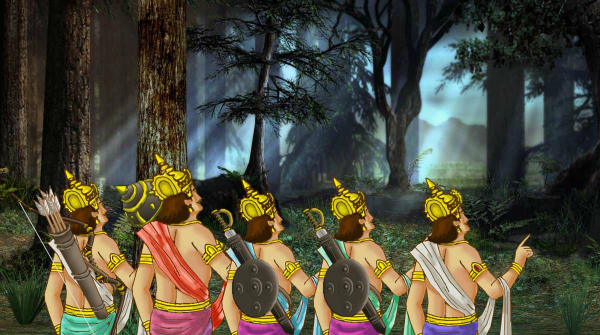
The Pandavas. Source: India Times. 
from Indian Myth and Legend by Donald A. Mackenzie
  • Plot: The five sons of Pandu are introduced. Kunti is the mother of Yudhishthira, Arjuna, and Bhima. Madri is the mother of Nakula and Sahadeva. They are known as the Pandavas. They are all believed to be the sons of actual gods and not Pandu. One day King Pandu dies by merely touching Madri like some brahmin had told him. The wives, Kunti and Madri, argued about who should be burned with him and go with her husband to death. The Pandavas having heard their dispute decided that it should be Madri because she was King Pandu's favorite wife. Therefore, she was laid on the pyre next to her husband and passed away. 
  • I like this chapter because it introduces the Pandavas who are the main characters in the Mahabharata. It's going to be a little funny for me reading the rest of this because I've seen the show and I can still remember the actors' faces so I will be imagining them in my head. 
  • Strong points in this chapter:
    • I like that all of the it tells who's the father, the god, of each individual son. I'm sure the description of what the god is known for also is going to play a big part in how each son's personality turns out.
  • For some reason I thought of the game show when I read the paragraphs about the introduction of the sons, so maybe I can incorporate that into a story somehow.

Friday, September 21, 2018

Reading Notes: Kumbhakarna, Part D

Kumbhakarna versus the Apes. Source: Wikimedia. 

from Indian Myth and Legend by Donald. A Mackenzie

  • Plot: The desperate rakshashas are trying to awaken the mightiest demon of all, Kumbhakarna. Men danced and shouted and blew trumpets right by the demon but he never woke. He was ran over by elephants but never woke. But when he was caressed by women, he suddenly woke up and screamed in rage about why we was woken up so early. He was informed about the situation by the rakshashas and he became ready to devour the apes. When the apes saw him, they are ran away in panic but Sugriva rallied them all back and they began to fight. Kumbhakarna beat Hanuman, and devoured the other apes. However, he was beheaded in the end by Rama. 
  • For some reason, the fact that Kumbhakarna slept a lot reminds me of a bear in hibernation. I could write a story as Kumbhakarna depicted as a bear and the rakshasas are evil humans who try to use him in a war against the good humans. 


Wednesday, September 19, 2018

Readings Notes: Sita and Ravana, Part C

from Myths of the Hindus and Buddhists bu Sister Nivedita

Sita at Ashoka Woods. Source: Wikimedia.

  • Plot: Hanuman sees someone looking weak and thin on the stairs of a marble palace and comes to the conclusion that it is Sita. He gets happy thinking that he finally found her. Ravana wakes and goes to the Ashoka wood with his train of women. He goes to Sita and tries to woo her but to no avail. Sita profusely rejects him and tells him he's going to die by Rama's hands. Ravana in his rage says that he will give a two-month term and if she didn't yield by then, he would torture and slay her. He leaves with his wives and a scared Sita creeps into the foot of the Ashoka tree where Hanuman is hiding.
  • Strong points: the figurative language used through the chapter.
    • The way Hanuman describes how Sita looks. "Weak and thin as if with fasting, sighing for heavy grief" and "guarded by horrid rakshashis, like a deer among the dogs or a shining flame obscured by smoke." 
    • I also liked how the way the wives followed Ravana is described. "Followed their heroic husband like lightings followed a cloud."
  • For my story, I could write this whole chapter in the other character, Sita's, point of view. I think I could use some figurative language in my story, especially when describing how Ravana would look like when he was trying to woo her and when he was in his rage.


Wednesday, September 5, 2018

Reading Notes: The Chase, Ravana and Sita, Part B

from Indian Myth and Legend by Donald A. Mackenzie
  •   Plot: The demon Maricha is disguised as a golden deer. He is pierced through heart with an arrow by Rama. Maricha in turn mimics Rama and tricks Sita into thinking that Rama had actually died. Lakshmana actually realized that it is not his brother and this makes Sita mad. 
  •  I loved all the dialogue in this certain chapter. It gave me an idea on how to write dramatic dialogues for my own story.

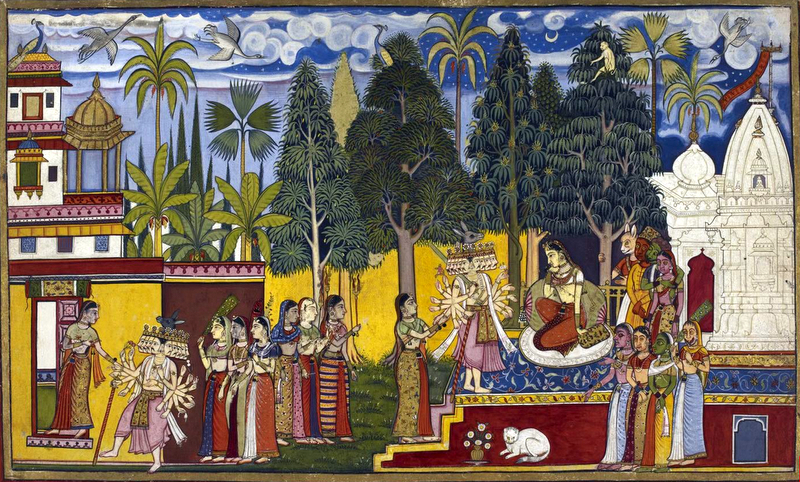
Ravana kidnapping Sita. Source: Flickr.


from Indian Myth and Legend by Donald A. Mackenzie and Ramayana, The Epic of Rama, Prince of India by Romesh Dutt
  •       Plot: Ravana, the king of Lanka, is a Rakshasa. He disguises himself as a wise man so he can talk to Sita because he is enchanted by her beauty. He flirts with Sita and tries to convince her to become his wife. Sita gets furious and asks him “do you know who I am? I am the wife of the god-like Rama.” Ravana in a fit of rage, abducts her and flies off into the sky on his chariot. 
  •  Once again, I liked all of the dialogues in this chapter. I specifically liked when Ravana said “I can torture the sun and shoot arrows through the earth.” I personally believe that one line has strong imagery and just something powerful about it. 
  •  I think something I could do for this story is switch the viewpoints for both Ravana and Sita and write it in a more modern way. 


Tuesday, September 4, 2018

Reading Notes: PDE Ramayana, Part A


Ayodhya, the setting of the Ramayana. Source: Wikimedia.

from Indian Myth and Legend by Donald A. Mackenzie
Right off the bat, I loved the attention of detail to the setting in the King Dasharatha chapter. I think the author described the setting in such a way that you can imagine the place in your head and that is something that I want to incorporate in my story. I think I will actually look up a real place and try to describe it as best as I can in words.
from Myths of the Hindus and Buddhists by Sister Nivedita
In the Vishvamitra chapter, I like that the brothers Rama and Lakshmana set out on an adventure. I started watching the show Supernatural on Netflix this summer and the two brothers in that show set out on adventures in every episode to do a new “job”, kind of like how these two brothers are. I think I might incorporate some of that show into my story too. In fact, the more I think about it, the more I can see the similarities in the show and this epic. 

Wednesday, August 29, 2018

Reading Notes: Jataka Anthology, Part B

I enjoyed reading the Jataka Anthology very much. They were all written very well, and I got some good ideas on how I want my own story to turn out. I couldn’t just pick one that would be the kind of writing style I would go with. Instead I picked some ideas from 2 different stories that I think I could incorporate into my own writing. 

The Turtle being carried away by the Geese. Source: Wikimedia.

The first one that I really liked was the Two Turtle Jatakas by Ellen C. Babbitt. I liked the way the author showed the turtles’ personalities through the writing. In the first one, The Turtle and the King, I like that the turtle is portrayed as a naïve, helpless turtle until the very end when he actually tricks them into letting him go. And in the second one, The Turtle and the Geese, this turtle is portrayed as kind of an arrogant character because he kept talking too much. I thought at the beginning that the turtle in this story would be like the one in the “The Tortoise and the Hare” fable, but he turned out to be completely the opposite so I found that interesting. It would be a good idea to take a famous story like that and add a twist to it. 

The second story I really liked was The Foolish, Timid Rabbit also by Ellen C. Babbitt. In this story I liked that she added many different characters, and was still able to keep the Rabbit as the main character. Sometimes I can get sidetracked and end up writing about a different or minor point, so I think I’ll definitely come back and see how she kept the Rabbit as the center of attention. The story also reminded of the Disney movie Chicken Little. In that movie the character Chicken Little also thinks the “sky is falling” because he mistook a piece of a UFO to be a piece of the sky. 

The more stories I read, the more I realize that there are so many versions out there and every author adds their own sort of twist to it.

Tuesday, August 28, 2018

Reading A

After going through all of the reading options we have for Ramayana and Mahabharata, I think I am going to go with the PDE options for both epics. I like that there is an audio option because that means I can even listen to it on my commute home. I like that there is also text that goes with it so I can read along or just read if I want to. When I first saw that the PDE: Ramayana was like 80 pages, I was a little overwhelmed. But then I saw the readings weren't too bad. I saw that PDE: Mahabharata also has 80 pages as well so I'm definitely going to need to start reading both early on and not procrastinate on the readings. The readings I'm excited for are the comics. I've had friends who have taken this class before and say the comic books and the animated movies are the best parts. I watched a little bit of the Sita Sings the Blues video and I was actually really into it.

Sita Sings the Blues. Source: Wikimedia.


Monday, August 27, 2018

Growth Mindset

Through her TED Talk, I got to know about Carol Dweck and her idea of growth mindset. I like that she said "we can praise wisely, not praising intelligence or talent." I think that really helps a person, especially if they're already feeling low about their grade or their progress in a class or anything that is important to them. Instead of discouraging them, we should help encourage them to move forward. I think sometimes I am like that too. I'm not usually the type that needs approval or appraisal for everything I do, but sometimes if I did do something big or extraordinary, I like when someone will point it out and give me attention for it. Out of all of the growth mindset challenges, my favorite is the cat randomizer! I absolutely love memes and I think I can sit around looking for cat memes for a good few minutes.
I'm creating my online presence. Source: Growth Mindset and Feedback.

Sunday, August 26, 2018

The best Time Strategies for me.

Let me just start off by saying I am not that good at time management as I think I am. I have random bouts of energy, and that's when I do my best studying. I am also guilty of procrastinating quite a bit. After reading through some articles, I think I may have found some good tips to help with my procrastination though. In the article How to Beat Procrastination, I learned a new trick that I think I will try. In the article Increase your creative output with 14 time management tips just for creatives, I really found most of those tips to be really useful. I realized I already do some of the things like "work when you work best" and "do the worst things first." I'm the type anyway to get the worst things out of the way first. My custom schedule really goes well with this certain tip. I'm supposed to do both of my readings on Monday, and I usually take a while to get things read so I'm hoping I stick with this tip throughout the semester.

Time management clock. Source: Tyrrell and Company.